


Leonie Welzel is studying for a Master's degree in Social Work: Youth in Theory and Practice in the Faculty of Applied Social Studies(Opens in a new tab) and talks to us about the Federal Day for Social Work in Daycare Centers, in which she participated as a research assistant, about hurdles in academic life and about the connection between social background and education.
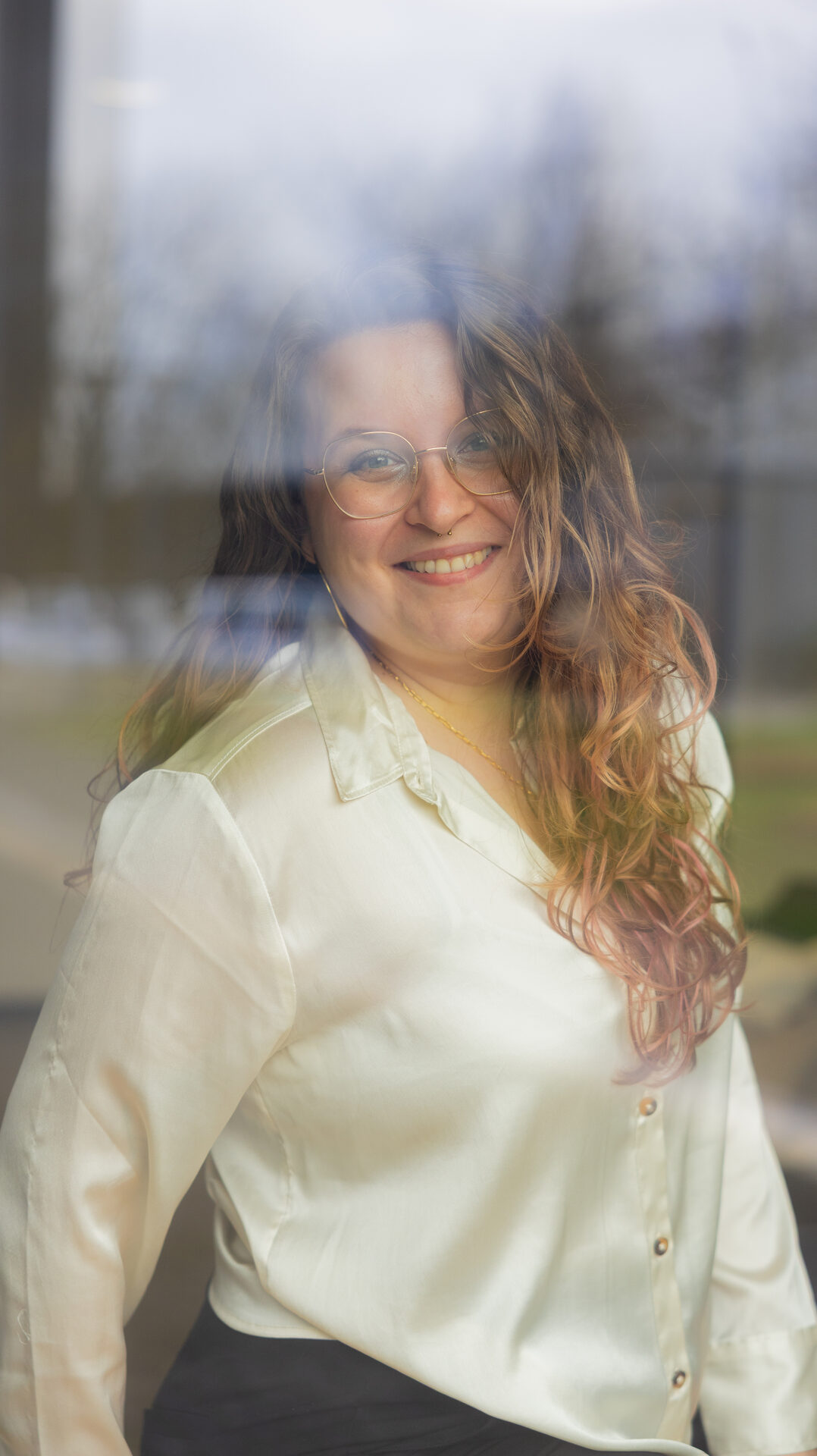
Please introduce yourself at the beginning and give us a brief introduction to the topic you would like to talk about today.
My name is Leonie Welzel and I am studying for a Master's degree in Social Work: Youth in Theory and Practice(Opens in a new tab) in the Faculty of Applied Social Studies at Dortmund University of Applied Sciences. In addition to my main job in a residential group for unaccompanied minor refugees, I have been working four hours a week as a research assistant for Prof. Dr. Viola Hartung-Beck(Opens in a new tab) since July 2025. At the end of September, I was able to accompany Ms. Hartung-Beck to Erfurt for the Federal Day for Social Work in Daycare Centers(Opens in a new tab) and help design a workshop there.
Please take us with you. How do you prepare for such a symposium and what was the process like on site?
In the run-up to the workshop, we held several meetings with Ms. Hartung-Beck and Salome Lutjiens, another research assistant. Here we worked on the scientific part of the presentation for the workshop. We first worked together to develop a structure and overall concept for the presentation and then created the slides individually. Ms. Hartung-Beck took over the communication with those responsible for daycare social work in the city of Dortmund(Opens in a new tab) , with whom she had already worked together in the context of the scientific support for the implementation of daycare social work in Dortmund, and maintained an overall view of the presentation. In addition, a meeting was held together with two employees from the City of Dortmund's prevention department. In this meeting, we designed the content and didactics of the workshop. Ms. Lutjiens and I documented the considerations, but were also actively involved in the discussion.
Ms. Hartung-Beck invited us research assistants to accompany her to the symposium in Erfurt and support her in conducting the workshop. The symposium took place on the premises of Erfurt University of Applied Sciences. We first prepared our workshop there, taking care of the technology and preparing the seminar room. At the beginning of the symposium, we listened to an opening lecture by Prof. Klinkhammer from the University of Augsburg and then went to our workshop. There I was allowed to give a small part of the presentation and also assisted with the group work phases. After the workshop and as a conclusion to the symposium, we listened to a final discussion in a lecture hall with experts in daycare center social work.
Leonie Welzel on the feeling of being at eye level during the symposiumAt the same time, my colleagues continuously gave me the feeling that I was working on an equal footing and that my perspective was highly valued. This enabled me to be more self-confident and master the challenges well.
How did they experience the symposium and what experiences and learning moments did they take away with them?
The fact that I was able to work on a workshop together with experienced colleagues was very enriching for me. Firstly, because the opportunity to take part in the symposium as a research assistant was already something special for me. I am very grateful for such a direct insight into the field of research, as this experience has broadened my interest in scientific work. Especially because I am the first person in my family to study, it was and is very special to have access to scientific-professional spaces.
The opportunity to actively participate in the workshop was also very exciting for me. I was involved in the concept planning, was allowed to take over part of the presentation and was later closely involved in the evaluation. This responsibility showed me how trustingly I was integrated into the team and gave me a feeling of real participation.
The biggest challenge for me personally was giving a presentation myself for the first time and then moderating part of the discussion, as my colleagues had much more expertise and routine. At the same time, my colleagues continuously gave me the feeling that I was working on an equal footing and that my perspective was highly valued. As a result, I was able to act more confidently and master the challenges well.
You mentioned that you were the first person in your family to go to university. What was your academic path like up to this point and what hurdles did you encounter?
My academic path began with a Bachelor's degree in Social Work at Münster University of Applied Sciences. I carried out a small qualitative study as part of my Bachelor's thesis and was subsequently encouraged by my supervising professor to start a Master's degree. Being the first person in my family to study at a university was a challenge, especially during my Bachelor's degree. I had difficulties finding my way around the academic environment and it is only now in my Master's degree that I feel I really understand how university "works". However, I never felt alone in this, as there are and were many people in my circle of friends as well as in my studies who were the first person in their family to study. In addition, and I am by no means the only one, I had to work alongside my bachelor's degree to afford rent and living expenses.
In Münster, I often met people who went to work in order to go on vacation or to be able to spend their free time in a nice way. For me and many others, it's about being able to live or pay tuition fees because the family can contribute little or nothing. Of course there is the possibility of support from the Bafög office, but not all students get Bafög approved, especially as the money is not enough to afford luxuries such as vacations or the like.
Leonie Welzel on the challenges of studyingI had difficulties finding my way in the academic environment and only now, in my Master's degree, do I feel that I really understand how higher education "works". [...] For me and many others, it's about being able to live or pay tuition fees because the family can contribute little or nothing.
In your opinion, how do social background and educational background influence access to the scientific world?
As already mentioned, financial resources play a major role in studying. Many students drop out of university because they can no longer afford it or because the double burden of work and university means it takes them a very long time to complete their studies. It is known that children of parents without a university degree are significantly less likely to complete a bachelor's degree (20 out of 100) than children whose parents have completed a degree (64 out of 100). If we talk about higher degrees, the differences become even more pronounced (11 vs. 43 for Master's degrees) (see Stifterverband für die Deutsche Wissenschaft e.V. 2021).
Students from less privileged backgrounds often find it difficult to assert themselves in the academic world because they do not have the same resources or networks available to them as others. As a result, they never feel completely at home in the academic world and perceive themselves as not belonging. Funding equal opportunities and offering support to first-year students is therefore immensely important.
What can educational institutions do to break down barriers for students from marginalized groups?
Colleges and universities should develop targeted programmes that are tailored to the needs of students from marginalized groups. These could include mentoring programs, financial support or workshops that focus on study organization and time management. It is also important to create an inclusive culture that values diversity and promotes exchange between all students.
Leonie WelzelFor me, diversity is [...] not an add-on, but a fundamental building block for scientific quality, relevance and social impact.

What positive effects do you see when different perspectives are incorporated into scientific discourse?
For me, one of the great strengths of academic discourse is that it should never be one-sided, because it gains in quality when diverse and less visible perspectives are included. It is particularly important to me to actively include perspectives that are given less space in an academic context or in society as a whole. These include, for example, the voices of queer people, people who have experienced racism, people with disabilities, but also non-academics or professionals who directly combine science and practical application. Marginalized groups in particular have valuable knowledge and areas of experience that are often not sufficiently taken into account in traditional research structures. If such perspectives are integrated, research becomes more intersectional and more sensitive to blind spots. Discriminatory mechanisms, structural inequalities or previously overlooked issues can thus be made visible and workable. For me, diversity is therefore not an add-on, but a fundamental building block for scientific quality, relevance and social impact.
We would now like to talk to you about your Master's program. Why did you choose the Master's degree program Youth in Theory and Practice at Fachhochschule Dortmund?
I opted for the Master's degree in Dortmund for various reasons. Firstly, the course is designed so that you work around 20-25 hours a week. The Master's is therefore longer, but for financial reasons I would not have been able to do a full-time Master's any other way. It's also important for me to continue my professional development. The focus on youth welfare was particularly interesting for me because I see my professional future in this area of work. Furthermore, the university is not far from where I live and I was pleased to experience university life on a large campus, because in Münster the various faculties are spread all over the city. As I am very interested in expanding my knowledge in designing and carrying out research projects, the research project in the fourth and fifth semester particularly appealed to me.
Leonie Welzel on the opportunities for research during your studiesAs I am very interested in expanding my knowledge of designing and carrying out research projects, the research project in the fourth and fifth semesters particularly appealed to me.
What are your goals for the future during and after your Master's degree?
During my studies, I would like to continue working as a research assistant because I have realized that I enjoy being able to help shape the scientific discourse. After graduation, I would like to work in a position that allows me to have a positive impact on the lives of young people. However, I don't put any pressure on myself, but trust my own pace. I could also imagine working in research as a research assistant in order to contribute to the further development of innovative approaches in social work.
Leonie WelzelI very much hope that existing barriers for marginalized people will be consistently dismantled and that social inequalities will not only be recognized, but visibly taken more seriously and actively combated.[...] Diversity in scientific practice thus leads to more socially just structures and findings that really have all people in mind.

Is there anything else she would like to tell us at the end of our interview that we have not yet discussed?
Finally, I would like to emphasize how important it is to me that research and education should not be seen as the privilege of individuals. Access to science must be possible for everyone, regardless of social background, financial resources, experiences of discrimination or other barriers. I very much hope that existing barriers for marginalized people will be consistently dismantled and that social inequalities will not only be recognized, but also taken more seriously and actively combated. I see great potential for social work in particular in this context, because if access to science is expanded and made easier, more students could take the step into a Master's degree or even into research. In my view, this would be a significant step forward, because inclusion in research ensures representation and representation helps to determine how we perceive, understand and shape society. Diversity in scientific practice thus leads to more socially just structures and findings that truly take all people into account.