Prize of the Fachhochschule Dortmund's sponsoring organization for the best graduates
Caroline Iser (Applied Social Sciences)
Topic of the bachelor thesis: "Inclusive exclusion": Drug consumption rooms and public tolerance areas for drug scenes
Supervising lecturer: Prof. Dr. Christine Graebsch(Opens in a new tab)
Explanation of the topic: I have taken a critical look at how local politics, the police, the public order office, security services and also drug support services influence where (and where not) people who use drugs are allowed to be in urban spaces. The work examines the connection between the spatial and social marginalization of drug users. I also explored the questions of what these spatial control measures are intended to signal and (supposedly) achieve and what they mean for those affected.
What happened after graduation?
Caroline Iser : I focused my studies on helping offenders, which is where I now work in Bremen - for a project that aims to prevent alternative custodial sentences. For me, this job is very compatible with my conviction for accepting and power-critical approaches in social work. Once I have gained enough relevant professional experience, I would like to do a Master's degree in criminology.
What did I like best about the University of Applied Sciences?
Caroline Iser : What I liked best about the University of Applied Sciences was that I was able to acquire basic knowledge and at the same time deepen my interests very well. Some lecturers particularly inspired me with their professional attitude and helped me to develop my understanding of my role as a future social worker.
Padra Namvar (Business Studies)
Topic of the bachelor thesis: Cognitive biases and the reception of negative information - an analysis in the Business Studies context
Supervising lecturer: Prof. Dr. Ralf Beck(Opens in a new tab)
Explanation of the topic: This thesis shows how cognitive biases systematically influence our thinking - from spontaneous gut feelings to erroneous assessments of complex situations. What is particularly exciting is that negative information has a disproportionate effect due to the so-called negativity bias, making it even easier for us to fall into mental traps. And this is precisely what resourceful communicators use to control perception and behavior in areas such as Business Studies, politics or marketing.
What happened after graduation?
Padra Namvar: After completing my Bachelor's degree, I started a Master's degree in Business Management at Fachhochschule Dortmund. At the same time, I work as a research assistant and deepen my knowledge in an academic environment.
What do I like best about the university?
Padra Namvar : I have found the approachability and helpfulness of many professors to be particularly positive. There is also the close link between theory and practice, which has enriched my studies both professionally and personally.
Christopher Nieder (Computer Science)
Topic of the Master's thesis: Conception and evaluation of a Car-To-X system for traffic flow optimization
Supervising lecturer: Prof. Dr. Martin Hirsch(Opens in a new tab)
Explanation of the topic: As part of the master's thesis, a completely decentralized algorithm was developed to avoid traffic jams on freeways. This uses car-to-car communication to detect traffic jams at an early stage and then controls the coordinated adjustment of vehicle speeds and lanes until traffic flows smoothly again.
What happened after graduation?
Christopher Nieder: Since completing my Master's degree, I have been working as a software engineer at Dortmund-based adesso SE, where I had already worked as a student trainee for four years during my studies.
What do I like best about the Fachhochschule?
Christopher Nieder: What I particularly appreciate about the Fachhochschule Dortmund is the practical training and the close connection to the professional world. The personal atmosphere and the direct exchange with lecturers have enriched my learning in the long term.
Nicolas Plancq (Design)
Topic of the Master's thesis: Compression - Perspectives on lossy perception
Supervising lecturer: Prof. Oliver Langbein(Opens in a new tab)
Explanation of the topic: In my thesis and my project "Reliefs", I investigated how compression affects our perception and thus also creates new, different meanings. How does compression as a cultural pattern shape our perceptions? AI, memes and pattern recognition show how ubiquitous compression is as a method.
What happened after graduation?
Nicolas Plancq: After graduating, I was able to work straight away at the storylab kiU at Fachhochschule Dortmund in Dortmund U in a cooperation project with the city of Dortmund. I'm curious about other exciting research projects at the interface of digitality, design and mediation.
What do I like best about the university?
Nicolas Plancq: I am grateful for the lasting inspiring encounters with teachers and I am happy about the friendships and companions. A special place for me was and is the storylab kiU, which gave me many extremely valuable and unique experiences during my studies and beyond.
Eric Schulte (Electrical Engineering)
Topic of the Master's thesis: Theoretical and practical analysis of a traction inverter for commercial vehicles, construction and agricultural machinery
Supervising lecturer: Prof. Dr. Bernd Runge(Opens in a new tab)
Explanation of the topic: A so-called traction inverter was examined in the thesis. This is an essential component of the drive train of electric vehicles, which is necessary for the conversion of energy forms between the electric motor and the battery. The main aspect of the investigations was the electrothermal performance of the system.
What happened after graduation?
Eric Schulte: After completing my dual Bachelor's and Master's degree with Infineon Technologies AG, I continued to work there as a product engineer in the Automotive Power Modules division.
What did I like best about the university?
Eric Schulte: I particularly liked the application-oriented approach and the small groups.
Nick Schuto (Mechanical Engineering)
Topic of the Master's thesis: Mode of action of passive valve elements in pilot-controlled pressure relief valves with regard to optimizing the spring response of semi-active vehicle vibration dampers
Supervising lecturer: Prof. Dr. Vinod Rajamani(Opens in a new tab)
Explanation of the topic: The Master's thesis is subject to a blocking notice.
What happened after graduation?
Nick Schuto : After a short break, I started working at an accredited testing laboratory in Bochum in January 2025 as a test and project engineer in the field of electromagnetic compatibility (EMC) and later in the field of environmental simulation and vibration. The business generally deals with the standard-compliant testing of products from a wide range of industrial sectors.
What did I like best about the university?
Nick Schuto : I particularly liked the informal atmosphere in terms of working with fellow students and especially the lecturers. I didn't really have the feeling of being anonymous ("just a number") as a student on either the Bachelor's or Master's degree course. I also found the experiences and anecdotes from working in the private sector, which the lecturers shared with the students outside of the lecture content, particularly interesting, entertaining and valuable.
Marc Stiegemann (Information Technology)
Topic of the bachelor's thesis: Research on the automated quality assessment of bicycle routes
Advisor: Prof . Dr. Reinhard Scholz
Explanation of the topic: This projectfocuses on the automated collection, analysis, and visualization of bicycle tour data. The thesis examines the automated quality assessment of bicycle routes, building on previous project work. In that project, the bicycle was equipped with sensors, and the data from those sensors was processed in the bachelor’s thesis.
What happened after graduation?
Marc Stiegemann: First as a smart meter gateway administrator, then as an IT network administrator at the local energy provider.
What did I like best about the University of Applied Sciences?
Marc Stiegemann: First of all, I appreciated how the Fachhochschule Dortmund handled the COVID-19 crisis, since I began my studies under COVID-19 restrictions. I also really enjoyed the various projects, the hybrid study model (online and in-person), and the people at Fachhochschule Dortmund.
Jan Stöcker and Martin Vagedes (Architecture)
Topic of the Master's thesis: Innovative production methods for metallic façade elements
Supervising lecturer: Prof. Dr. Helmut Hachul(Opens in a new tab)
Explanation of the topic: The thesis investigates whether complex façade parts can be produced by deep drawing using simple molds such as 3D printing or CNC. Tests show precise deformations of thin sheet metal. The process offers potential for affordable and efficient façade solutions.
What happened after graduation?
Jan Stöcker: I was already working as a student trainee at wp2 Architekten in Dortmund during my studies. After graduating, I took a job as a site manager at wp2.
Martin Vagedes: After completing my Master's degree in "Building envelopes made of metal" with Prof. Dr.-Ing. Hachul at the University of Applied Sciences, I started working at Attelmann Architekten in Bochum. There, he applied his knowledge of metal façades and roofs to commercial buildings. The Master's degree was the perfect preparation for starting a career.
What did I like best about the university?
Jan Stöcker: In my opinion, the best thing about the University of Applied Sciences is the proximity to the lecturers and the sense of community and friendships that were forged through the many night shifts we worked together.
Martin Vagedes: What I particularly liked about Fachhochschule Dortmund was the personal support from dedicated professors and staff, especially Prof. Dr.-Ing. Helmut Hachul and his team, who support each student individually. The practice-oriented degree program imparts sound specialist knowledge and prepares students optimally for professional challenges. You never feel like a number here, but part of a supportive community with high standards of quality and practical relevance.
Prize of the Fördergesellschaft for special achievements in research and teaching
Research prize: Harald Opel (story Lab kiU)
Research area: "not to exclude that it is true" - identity and narration in digital 3-dimensional space, including XR projects, development of immersive spaces, fulldome and 3D facade mapping with the storyLab kiU at Fachhochschule Dortmund
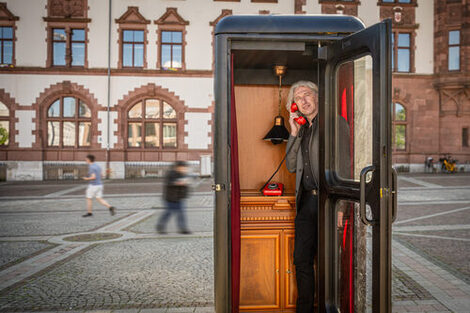
What exactly am I investigating as part of our research?
Harald Opel: "As long as I am not asked what I am researching, I know exactly." The quote (Augustine of Hippo) refers to the question of what is the identity of time. My research is also about time, space and identity. The projects "page21", "Do you exist Miss Q" or the 3D facade mappings as examples take up realities and identities of artworks, people or buildings and change and distort them in multilinear digital worlds in order to place them in current social contexts. It is about parallelism and the approximation of technical formats to human perception
What main insights have I been able to gain from my research so far?
Harald Opel: "not to exclude that it is true" - the title of the current research project - refers to both the credibility of aesthetics and the credibility of narratives. Credibility is not created through visual and auditory perfection. It comes from accuracy in the narrative. And this can only be defined by analyzing human perception. What is needed is expertise in psychology, politics, dramaturgy, visual art and computer science. In other words, a wide-ranging team - at least that could be true.
Teaching award: Prof. Dr. Nadja Bauer

Faculty of Computer Science
Statement of the student council: Prof. Dr. Nadja Bauer's courses are characterized by a profound understanding of the subject matter. Prof. Bauer is always open to questions and provides detailed and comprehensive explanations. In her lectures, she links various topics and related concepts. [...] In her exercises and projects, Prof. Bauer always establishes a practical link between the content covered in the lecture and the working world of a data scientist. She also draws on her own professional experience.
In the student body, she is regarded as a person who can explain difficult concepts (especially in the field of mathematics) in a simple and easy-to-understand way. She explains problems in a way that includes all students regardless of their level of knowledge and language skills. Her preparatory mathematics tutorials for first-year students have made it easier for many to get started.
Prof. Dr. Naja Bauer is also significantly involved in the planning and implementation of the "FemInf" events, which are intended to provide a protected area within computer science studies in which women can support each other in their studies. Prof. Bauer is also involved in the Women's Advisory Board of the University of Applied Sciences. [...]

Prize of the Fördergesellschaft for outstanding cooperative doctorate
Dr. Jonas Sorgalla (Computer Science)
Topic of the doctorate: Empowering Collaboration in Microservice Engineering
Supervising lecturers: Prof. Dr. Sabine Sachweh(Opens in a new tab) (Fachhochschule Dortmund) and † Prof. Dr. Albert Zündorf (University of Kassel)
Explanation of the topic
Jonas Sorgalla: My work examines how technical and organizational factors have to interact in order for teams to work together successfully in the development of so-called microservice architectures - i.e. software that consists of many small, independent programs. Success depends less on the technology and more on how teams are organized, interact with each other and distribute responsibility - I also developed suitable tools for this.
What happened after your doctorate?
Jonas Sorgalla : During the final phase of my dissertation, I was given the opportunity to join adesso SE as a team leader on January 1, 2024 and set up a new team for software development in public administration. After successfully defending my doctorate at the end of 2024, I developed the team into a competence center of its own. Since October 2025, I have been working as Tech Lead for the digitalization of healthcare at Techniker Krankenkasse.
What did I like best about the University of Applied Sciences?
Jonas Sorgalla : What I appreciated most about Fachhochschule Dortmund was that I always had the space and support to try out new things and develop myself further - first as a student in exchange with inquisitive fellow students and inspired by dedicated professors, and later as a research assistant alongside incredibly talented colleagues.
Sponsorship award of the Soroptimist International Club Dortmund
Marina Reinert (Mechanical Engineering)
Topic of the bachelor thesis: Transient thermography for thermal analysis of material stacks
Supervising lecturer: Prof. Dr. Vinod Rajamani(Opens in a new tab)
Explanation of the topic: Electronic components are becoming ever smaller, faster and more powerful. A lot of heat is generated in a very small space, which needs to be dissipated efficiently so that the components can function reliably for a long time. In my work, I investigated how heat is conducted through different material stacks. This is an important step towards reliable components.
What happened after graduation?
Marina Reinert : Before my degree, I trained as a materials tester and then worked in the materials technology laboratory at the South Westphalia University of Applied Sciences in Soest - alongside my joint degree at Fachhochschule Dortmund. After completing my Bachelor's degree, I continued to work at the South Westphalia University of Applied Sciences in Soest, now as a research assistant. I also take on the role of decentralized equal opportunities officer in the Faculty of Mechanical Engineering and Automation Technology.
What do I like best about the university?
Marina Reinert : What I particularly liked about Fachhochschule Dortmund was the form of the joint degree program. It was designed in such a way that I was able to combine my studies perfectly with my full-time job. At the same time, I felt very well guided and supported throughout my studies.
Cornelia-Därmann-Nowak-Award of the Soroptimist International Club Dortmund-Hellweg
Franziska Troja (Mechanical Engineering)
Topic of the Master's thesis: Simulation-based evaluation of the influence of thermo-mechanical effects on the thermal impedances of power modules without a base plate
Supervising lecturer: Prof. Dr. Markus Thoben(Opens in a new tab)
Explanation of the topic: The Master's thesis is subject to a blocking notice.
Commitment : Franziska Troja is actively involved in various voluntary activities, particularly in children's and youth work and in clubs. As a leader on vacation camps, she takes responsibility for looking after and accompanying children and young people. She is also an extended board member of the marching band and a board member of the local tennis club. She also coaches a youth dance group, where she encourages young people with a great deal of commitment and enthusiasm.
What happened after graduation?
Franziska Troja: Even after completing my Master's degree, I continued to work for the company and switched to the development of power modules for the automotive industry. There I work as a mechanical designer on innovation projects and continue to carry out mechanical and thermal simulations.
What did I like best about the university?
Franziska Troja : What I particularly liked about Fachhochschule Dortmund was that the professors have an industrial background and incorporate their practical experience into the course content. I also particularly appreciated the high practical component of the courses, which creates a close link between theory and application.
Prize of the Rudolf Chaudoire Foundation
Bjarne Karwik (Electrical Engineering)
Topic of the bachelor thesis: Development of a decision model for the synthetic and analytical balancing procedure from the perspective of the distribution grid operator
Supervising lecturer: Prof. Dr. Michael Berger(Opens in a new tab)
Explanation of the topic: In order to ensure the security of supply of the electricity grid, the balancing of feed-in and withdrawal must always be guaranteed by the transmission system operator. The distribution system operator is responsible for the clear allocation of the energy quantities to the balancing groups with the help of two balancing procedures provided in order to be able to allocate the costs incurred for balancing. Within the thesis, a specification for a mathematical model was developed with regard to the Business Studies of the procedures.
What happened after graduation?
Bjarne Karwik: After completing my Bachelor's degree, I initially took some time out to explore South Korea. When I returned to Germany, I started working as an energy data manager for a distribution grid operator. Among other things, I am responsible for balancing the grid in the electricity sector.
What did I like best about the university?
Bjarne Karwik : What I liked best about Fachhochschule Dortmund was the direct exchange with lecturers and students in a family/class-like atmosphere. With regard to my study program, I also found the treatment of current topics and the outlook for the future of the energy industry to be positive.
Lars Koers (Electrical Engineering)
Topic of the master thesis: Setup of test environments based on a Xilinx Zynq SoC for measuring the leakage current and for radiation qualification of SRAM based FPGAs
Supervising lecturer: Prof. Dr. Michael Karagounis(Opens in a new tab)
Explanation of the topic: The thesis deals with the development of test environments with a system-on-chip. One part of the thesis deals with the measurement of leakage currents of an FPGA with regard to temperature and voltage. The second part deals with the radiation qualification of two FPGAs for the classification of a possible use at CERN.
What happened after graduation?
Lars Koers: After my Master's thesis, I accepted a position as a development engineer at DB InfraGO AG. Here I am responsible for the development of test systems in the field of safety and control technology.
What do I like best about the university?
Lars Koers : I always liked the uncomplicated contact with the professors at the university. The course groups were rather small, especially in the Master's program, which allowed for intensive teaching and exchange.
Jan Nordhausen (Electrical Engineering)
Topic of the Master's thesis: Development of a dynamic torque and speed control for a frequency converter for use in test systems for electric motors
Supervising lecturer: Prof. Dr. Nick Raabe(Opens in a new tab)
Explanation of the topic: The thesis was written in a company that manufactures test benches for electric motors. The core of the thesis was the investigation of various methods for controlling the torque and speed of electric motors.
What happened after graduation?
Jan Nordhausen: I work as a trainee at Stadtwerke Bochum as a project engineer in the electricity plant engineering department.
What did I like best about the university?
Jan Nordhausen: What I liked best was the practical relevance of the teaching, especially the internships and project work.
Jan Erik Atmann (Mechanical Engineering)
Topic of the Master's thesis: Development of a Modular Data Interface for Battery Module Monitoring during 2nd-Life Requalification
Supervising lecturer: Prof. Dr. Markus Thoben(Opens in a new tab)
Explanation of the topic: The thesis deals with the software and hardware development of a modular data interface for battery modules. This interface is used in battery module test systems to collect, monitor and store cell data in a database during the requalification tests of used EV battery modules. The aim is to be able to adapt the interface to a variety of different battery modules and communication protocols with little effort in order to increase flexibility in the requalification of different module types.
What happened after graduation?
Jan Erik Atmann : After writing my thesis in collaboration with Voltfang GmbH in Aachen, I stayed on at the company. Since then, I have been working on building up our aftersales and service team and am responsible for the smooth operation and automated monitoring of our storage systems.
What did I like best about the university?
Jan Erik Atmann : What I particularly liked about Fachhochschule Dortmund was the practical relevance through projects and laboratories. Furthermore, the small course sizes created a very personal environment in which direct contact with the lecturers was always possible. The uncomplicated handling of external theses in industry is also a great advantage at Fachhochschule Dortmund.
Stefan Behnk (Mechanical Engineering)
Topic of the bachelor's thesis: Initial assessment of time management with a focus on determining the potential of an assembly system using the example of vacuum cleaner products
Supervising lecturer: Prof. Dr. Stefan Hesterberg(Opens in a new tab)
Explanation of the topic: The Master's thesis is blocked.
What happened after graduation?
Stefan Behnk: After completing my Master's degree at Fachhochschule Dortmund, I started working at Börger GmbH as a process optimizer.
What do I like best about the university?
Stefan Behnk: I particularly appreciated the strong practical orientation of the course and the close exchange with the professors. The opportunity to acquire additional qualifications such as the Lean Six Sigma Green Belt, the REFA basic certificate in work organization or the DGQ Manager Quality Junior was a great added value for me. I was able to apply the content I learned during my REFA training directly in my Master's thesis.
Tobias Haget (Mechanical Engineering)
Topic of the Master's thesis: Development of a calculation model for competitive systems based on award information
Supervising lecturer: Prof. Dr. Flavius Guias(Opens in a new tab) / Sebastian Kummler (Dürr Systems AG)(Opens in a new tab)
Explanation of the topic: In mechanical and plant engineering, many contracts are awarded in a tendering process. The model developed as part of the Bachelor's thesis is intended to estimate both the company's own costs and the prices of its competitors on the basis of tender content and customer requirements.
What happened after graduation?
Tobias Haget: After completing my Bachelor's degree, I started my Master's degree in Technology Management at the University of Stuttgart. After two semesters in Stuttgart, I went to the University of Tokyo for a research semester. I started my Master's thesis in October 2025.
What did I like best about the university?
Tobias Haget: The practical day-to-day studies, the good student support and the central location of the Sonnenstrasse campus.
Anton Altmeyer (Information Technology)
Topic of the bachelor thesis: Pulse arrival time and blood pressure estimation using the photoplethysmogram / Photoplethysmografische Schätzung der Pulswellenankunkunftszeit und des Blutdrucks
Supervising lecturer: Prof. Dr. Benjamin Menküc(Opens in a new tab)
Explanation of the topic: The photoplethysmogram (PPG) is often used for continuous, non-invasive blood pressure monitoring, as it can record various vital parameters. Since the combination with the electrocardiogram (ECG) is often unreliable in mobile environments, approaches that estimate blood pressure via pulse wave velocity (PWV) or the pulse arrival time (PAT) derived from it are being investigated. This work utilizes a large biosignal database to extract PPG features and use AI models to predict blood pressure based solely on these features and PAT.
What happened after graduation?
Anton Altmeyer: First, I started my Master's degree in Health Informatics at the Karolinska Institutet in Stockholm. This summer I then had the privilege of working for BIOTRONIK/MSEI in Applied Research as a Machine Learning Engineer with a focus on chronic heart failure and implantable cardiac monitors (ICMs). After my Master's degree next year, I will either start a professional career in the USA or a PhD program at Harvard University, MIT, Stanford University, etc.
What did I like best about the University of Applied Sciences?
Anton Altmeyer: The proximity to the research and development of various products and technologies in medical technology as well as the choice of my own learning path through the various practical assignments (project work 1 and 2 and Bachelor's thesis). In addition, the proximity to the professors and their commitment to providing the best support and help.
Konstantin Moss (Information Technology)
Topic of the Master's thesis: Optimization of the test process of the E/E system architecture of semi-trailers
Supervising lecturer: Prof. Dr. Hendrik Wöhrle
Explanation of the topic: The Master's thesis deals with the optimization of the test process of the E/E system architecture of semi-trailers. Both project management-specific and test-specific aspects are addressed in the form of concepts. In order to assess the influence of these concepts on the optimization of the current development and test process, their benefits are evaluated with the help of current literature.
What happened after graduation?
Konstantin Moss: After graduating, I changed industry and subject area and now work as an embedded software developer for charging infrastructure systems at Nidec SSB Wind Systems in Salzbergen.
What do I like best about the Fachhochschule Dortmund?
Konstantin Moss: What I particularly liked about the Fachhochschule Dortmund was the personal and direct exchange between students and professors. The university also offers interesting study programs that are characterized by a high degree of practical relevance.
Mohamad Sayad (Information Technology)
Master's thesis topic: Development and implementation of a high-frequency power amplifier (RFPA) for MRI applications
Supervising lecturers: Prof. Dr. Benjamin Menküc(Opens in a new tab)
Explanation of the topic: The aim was to develop a signal amplifier that is suitable for use in medical technology. The work consisted of designing, assembling, equipping and testing the amplifier.
What happened after graduation?
Mohamad Sayad: I work as a high-frequency engineer at the company iThinx GmbH. We develop IoT gateways that are put into operation in the RF range. It's about antenna simulation, adaptation, testing for qualification and approval of the gateways.
What did I like best about the university?
Mohamad Sayad: I really liked the collaboration between students and professors. You were always motivated to improve. And you learned a lot in the process, which was fun.
Prize of the KARL KOLLE Foundation
Ellen Bromkamp (Information Technology)
Topic of the Master's thesis: Investigation of antennas for body area networks with EMPro from Keysight
Supervising lecturer: Prof. Dr. Frank Gustrau(Opens in a new tab)
Explanation of the topic: I investigated whether antennas of body area networks have an effect on human tissue and whether heating occurs in the tissue. To do this, I modeled various antennas and body models from the literature in EMPro. I compared the calculated results with those from the literature and evaluated them.
Commitment: Friedensdorf International Oberhausen treats and cares for children from war and crisis zones free of charge in Germany. Ellen Bromkamp's job is to be there for the girls once a week. This means that she spends an afternoon playing with them, listening to them or simply spending time with them.
What happened after graduation?
Ellen Bromkamp: I started a job as a junior project manager for immission control in May. For example, I assess the immissions at planned buildings. We check whether the planned building or the surrounding buildings are too loud.
What did I like best about the University of Applied Sciences?
Ellen Bromkamp : What I particularly liked about the University of Applied Sciences was the practical content of the lectures, where what I learned was applied in practice. All the lecturers always had an open ear for our questions and supported us with help and advice. The University of Applied Sciences is an open place where everyone is treated equally and no one is excluded.
Nick Nuxoll (Mechanical Engineering)
Topic of the bachelor thesis: Fiber composite-compatible design of a roof spoiler for a hypercar in prepreg technology
Supervising lecturer: Prof. Dr. Matthias Müller(Opens in a new tab)
Explanation of the topic: My thesis was about designing a complex carbon roof spoiler contour in such a way that it can be mass-produced as cost-effectively as possible using prepreg technology. To do this, I specified a clever internal structure with CFRP inserts and expanding foam in order to optimize the weight and reduce material costs - lightweight construction without cutting costs, so to speak! The result was the production-oriented design of the overall system, which combines top component quality with a lean, economical process.
Commitment: As a student assistant, Nick Nuxoll supports the implementation of the Mathematics 1 and 2 courses in classroom and online formats. In the Formula Student Team at Fachhochschule Dortmund, he was instrumental in rebuilding the team. His tasks included recruiting new members, developing the team strategy, sponsoring, budget planning and managing the "Chassis and Body" assembly group.
What happened after graduation?
Nick Nuxoll: My path at Capricorn Composites GmbH began with my internship semester, where I was also able to successfully complete my thesis. After graduating, I started directly as a Composite Design Engineer, where I am responsible for the design of challenging fiber composite projects. The tasks range from series developments to motorsport and collaboration on our own hypercar project.
What did I like best about the university?
Nick Nuxoll: My personal highlight was working in the Formula Student team, as you had to put theoretical knowledge into hard practice straight away. This challenge taught us to think creatively and in a solution-oriented way and to focus on the important things. In addition, the very friendly interaction with professors and employees as well as the many support services such as tutorials were a great help.
Niklas Sommerfeldt (Electrical Engineering)
Topic of the bachelor's thesis: Design and development of a graphical user interface for a hand-held gas meter
Supervising lecturers: Prof. Dr. Nick Raabe(Opens in a new tab) and Michael Kopka (Magsys)
Explanation of the topic: In my thesis, I developed a user interface for a measuring device that measures a magnetic field based on the Hall effect. The challenge was to make it as easy to use as instant coffee, but hopefully with a slightly better taste. As it is a battery-operated handheld device, no computationally intensive graphics libraries were used in order to operate the device as energy-efficiently as possible.
Commitment: The Elsebad has been a community-run outdoor pool since 1998, where people of all generations have been coming together for many years. There are also numerous activities such as historical games, beach volleyball, handball and open-air cinema. Niklas Sommerfeldt is a volunteer there and it has always been a pleasure for him to work with many others to ensure that the Elsebad remains lively.
What happened after graduation?
Niklas Sommerfeldt: My dream is to develop innovative powertrains in the automotive sector. For this reason, I decided to start a Master's degree in Electrical Engineering at Munich University of Applied Sciences. In addition to the right study program, the main reason for choosing Munich was its proximity to the automotive industry.
What did I like best about the university?
Niklas Sommerfeldt : I particularly appreciated the respectful and appreciative communication at eye level. I experienced this both with the professors and with various departments at the university. Thanks to the Race-Ing. team, I was able to work with many of them. I would like to thank them once again for the good cooperation.
Franziska Wilp (Computer Science)
Topic of the master's thesis: A hybrid model for the collaboration of professional and citizen developers on low-code platforms - development and implementation of a concept using the Microsoft Power Platform as an example
Supervising lecturer: Prof. Dr. Marcel Hoffmann(Opens in a new tab)
Explanation of the topic: Then do it yourself! Software development is no longer a secret club for IT professionals. Colleagues from specialist departments can also get creative as so-called citizen developers and build their own apps. With the support of applied technologies GmbH, I have designed a model that brings both groups together so that software projects can be implemented faster, more successfully and with greater user satisfaction.
Commitment: The Nikolaushaus in Kemondo, Tanzania, is a children's home that provides a home for over 40 children and young people with and without disabilities. Franziska Wilp's commitment to the St. Nicholas House includes maintaining the website, direct work on site and targeted public relations work such as organizing and giving talks.
What happened after graduation?
Franziska Wilp: After graduating, I started my career at applied technologies GmbH. Today I work there as a software engineer and also take on project management tasks. I particularly like the fact that I can apply my knowledge from my thesis directly to exciting projects.
What did I like best about the university?
Franziska Wilp: At Fachhochschule Dortmund, I really appreciated the open exchange and the support from the lecturers. The variety of modules in the Master's program, which closely combine theory and practice, was also particularly exciting. This allowed me to try out a lot and find my own focus.
Heinrich Frommknecht Prize of the Heinrich and Christa Frommknecht Foundation
Julia Fuchs (Business Studies)
Topic of the bachelor thesis: Suitability of performance criteria for commission rate differentiation in remuneration systems of the exclusive distribution of non-life insurance companies
Supervising lecturer: Prof. Dr. Lukas Linnenbrink(Opens in a new tab)
Explanation of the topic: In my thesis, I investigated how non-life insurance companies can incentivize their agents through different commission rates. To this end, I examined which key figures are actually suitable for meaningfully reflecting the performance of the agents. The results of the analytical and empirical study show that Some key figures are useful, others rather not - and ultimately the suitability depends heavily on the company-specific framework conditions.
What happened after graduation?
Julia Fuchs: After completing my dual study program at Continentale Versicherung, I was offered a permanent position in the sales controlling department. Since April 2025, I have also been completing a part-time Master's degree in FACT with a focus on Risk and Finance at Fachhochschule Dortmund - continuing the proven combination of practical work and study.
What did I like best about the university?
Julia Fuchs: What I particularly like about Fachhochschule Dortmund is the high quality of the teaching, which means that even more complex content is taught in an understandable and practical way. The personal and respectful approach of the professors, who support us students in our personal and professional development through their understanding support and availability at all times, is particularly valuable. This mixture of professional excellence, high practical relevance and a pleasant atmosphere not only makes learning effective, but also really enjoyable.
Prize of the German Academic Exchange Service
Ivy Ivenna Chrystabell (Computer Science)
Commitment: Ivy Ivenna Chrystabell excels in basic and advanced subjects and is one of the best in her year. She is held in high regard by both fellow students and lecturers. In addition to her excellent academic profile, she is actively involved in the faculty and in social projects. As a student assistant and tutor for "Mathematics for Computer Science 2", she supports her fellow students with great dedication. Ivy Ivenna Chrystabell was also involved in the evaluation of a new professor as part of the pedagogical aptitude program. Her social commitment is also evident outside the university context: as a consultant for education and culture in the Indonesian Student Association Bochum-Dortmund, in her involvement in the Festival of Cultures and as treasurer of the Indonesian Christian Community (PERKI) in Bochum, she makes an important contribution to intercultural understanding. She has already been awarded the Germany Scholarship for her special achievements and commitment.
What do I like best about the university?
IvyIvenna Chrystabell: The motto "We focus on students" reflects exactly what I experience during my studies here. As an international student, studying in Germany is not always easy, but I always feel supported and well guided at Fachhochschule Dortmund.