Under the motto "Borrowing seeds - harvesting diversity", the seed library offers all members of Dortmund University of Applied Sciences and Arts the opportunity to grow different types of vegetables themselves free of charge.
"Borrowing seeds - harvesting diversity" is a project of the Association for the Conservation of Crop Diversity (VEN)
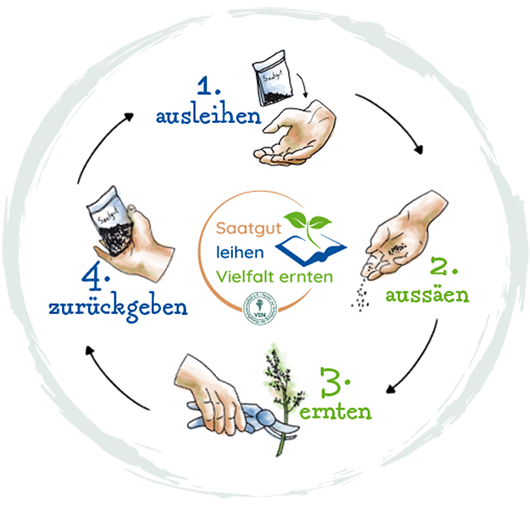
Would you like to grow your own vegetables on your balcony or in your garden and contribute to the protection of biodiversity at the same time? With the seed library at the Max-Ophüls-Platz location, we can help you do just that! It's very simple: you choose the seeds you want, plant them, harvest - hopefully - delicious vegetables and, if possible, bring us back one (or more) bags of newly harvested seeds a few months later. This creates a cycle from which as many students and employees of Fachhochschule Dortmund as possible can benefit.
The seed library is a joint project between the Library⁺ and Climate Protection Management. To get started, we obtained the seeds from the "Borrowing seeds - harvesting diversity" project run by the Verein zur Erhaltung der Nutzpflanzenvielfalt e. V. (VEN).
Questions and answers about the seed library
Where can I find the seed library?
In the library at the Max-Ophüls-Platz location (building MOP 2). No seeds are issued or accepted at the other two library locations.
How does lending work?
Seeds can only be lent from the start of the season (approx. mid/end of February) and until May of each year, while stocks last. It is quite possible that everything will be lent out in the first few weeks after the start of the season, in which case you will unfortunately not be able to get seeds from us again until the following year.
Only members of the Fachhochschule Dortmund are entitled to borrow seeds. First, choose the seeds you would like to borrow. Each person can borrow a maximum of 3 seed bags per type of vegetable and a maximum of 5 seed bags in total. Only a limited number of seeds are available for each type of vegetable, so it is first come, first served. Lending is only possible on site during the opening hours of the library at the Max-Ophüls-Platz location.
To borrow items, please present your FHCard or service card at the service desk. You will receive a reminder email from us during the season. There is no loan period for seeds and of course there are no reminder fees. However, we would be pleased to hear from you if you have not been able to harvest any seeds for return. There can be many reasons for this (e.g. unfavorable weather conditions or slug damage), but we rely on everyone who can to bring back seeds for the next season so that the cycle works in the long term.
Please make sure you keep the exact names of the varieties you grow. These are written on the bags and are important for the return (see below).
For employees of Fachhochschule Dortmund who would like to borrow seeds but cannot come to the library at Max-Ophüls-Platz, we are also happy to send seed bags by internal mail. If you are interested, please send an email to bibfh-dortmundde or use our contact form(Opens in a new tab).
How does the return process work?
When you borrowed the seeds, you also received an empty bag to fill with new seeds. Please use this preferably for the return. If you no longer have it or want to return more than one bag, please make sure that all bags are clearly labeled with the exact variety name (not just "yellow tomato" or similar) so that we can clearly assign the seeds.
Please note: Bean and pea seeds should be frozen for at least 21 days before being returned.
If you have not succeeded in harvesting new seed for return during the season, please notify us by e-mail.
What types of vegetables are available?
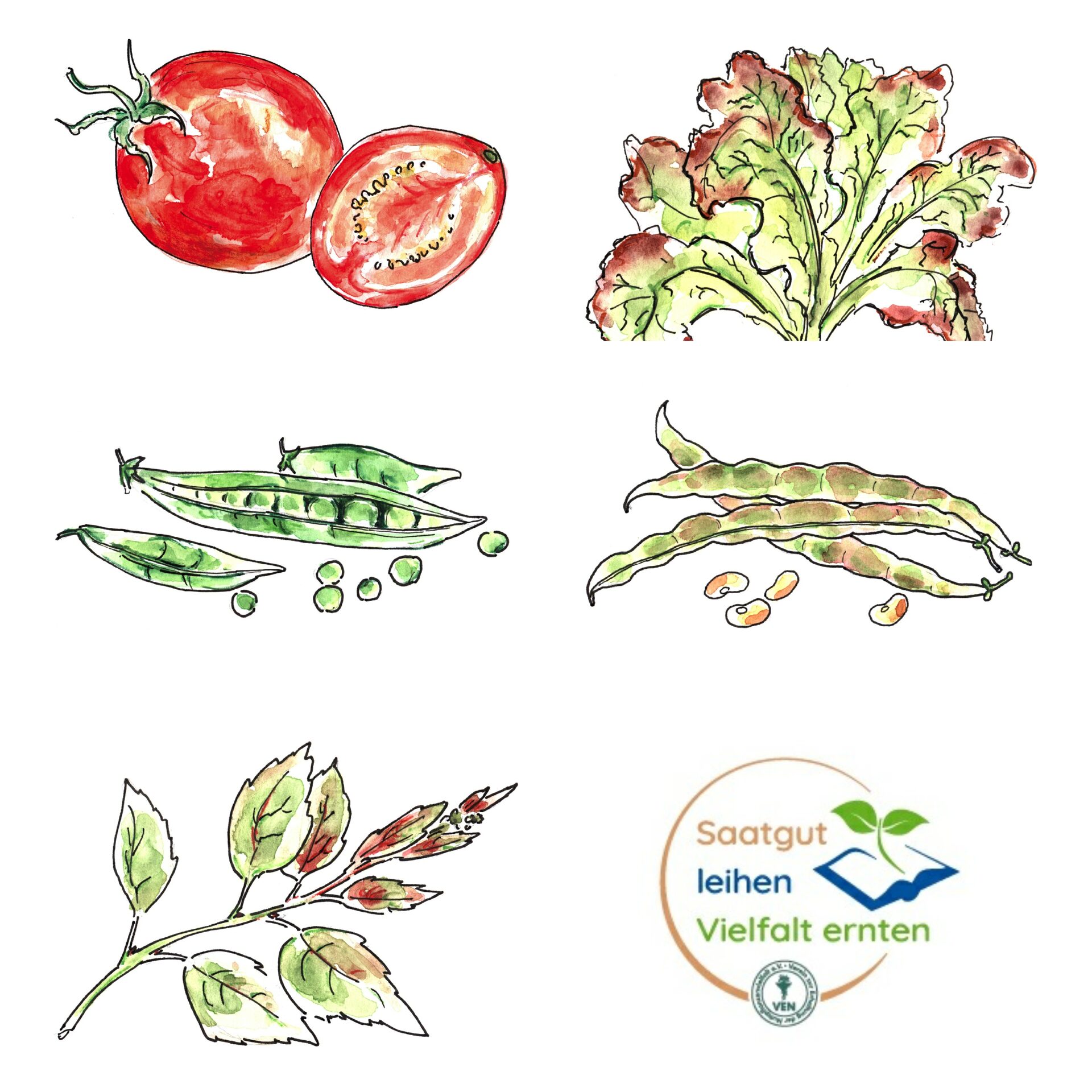
At the beginning of the season we have the following species to choose from:
Tomato
Lettuce
Bean
Pea
Garden pea
These species are particularly suitable for seed libraries, as undesirable cross-pollination is very rare.
We offer several different varieties of each species. On each seed bag you will find a description of the respective variety so that you can choose exactly the right one (while stocks last). We have taken care to include many varieties that are particularly suitable for growing on balconies, so that even amateur gardeners without their own garden can achieve good harvests.
Where do the seeds come from and why can they simply be passed on?
The seeds come from the gardens of various members of the Verein zur Erhaltung der Nutzpflanzenvielfalt e. V. (Association for the Conservation of Crop Diversity).
We only lend seeds for varieties without intellectual property rights. These may be propagated and passed on without restriction. They are seed-resistant and not restricted by hybrid technology. You can therefore propagate them yourself without hesitation.
Seeds for other species/varieties (e.g. wildflower seeds) are only given away by us - if available - as an accompanying gift.
Where can I find more detailed information on sowing plants and harvesting seeds?
We would like to recommend the website of the "Borrowing seeds - harvesting diversity" project. Here you will find information and tips for each type of vegetable under the respective tabs.
Does the library⁺ actually have any literature on gardening in its collection?
The library⁺ is of course not specialized in gardening/vegetable growing and its collection contains only a small amount of how-to literature. Nevertheless, it does provide some suitable titles, which you can find here: